Breaker Boys in the Kohinoor Mine (1891)
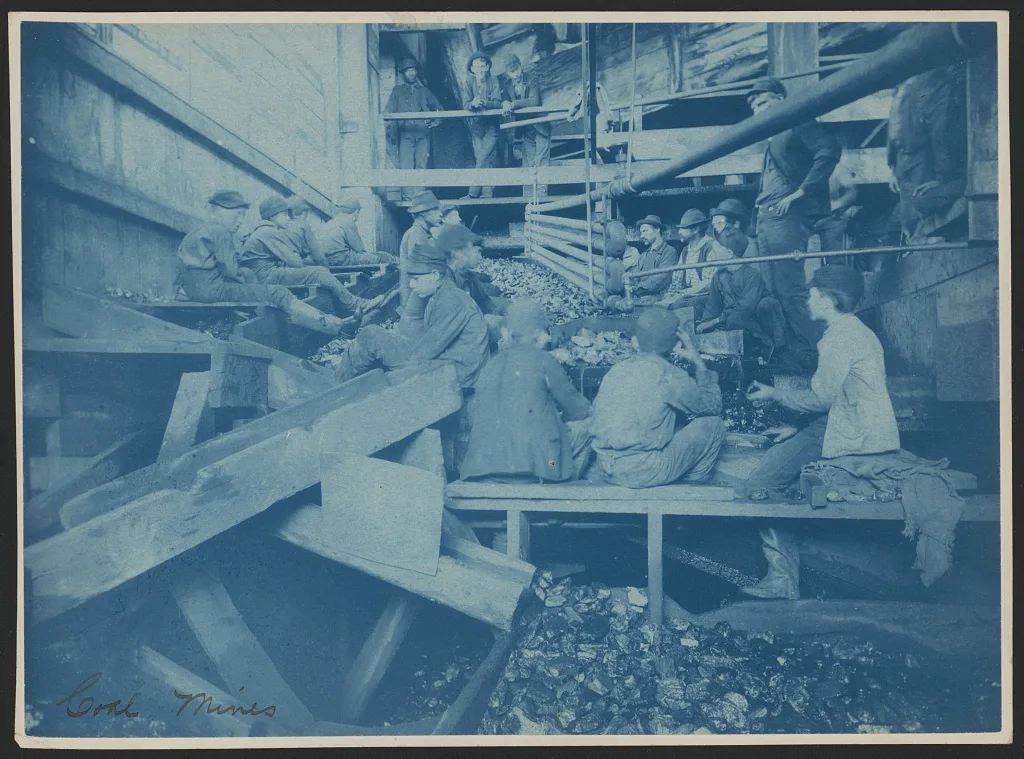
In 1891 Frances Benjamin Johnston photographed breaker boys, children who picked slate from coal by hand, at the Kohinoor mine in Shenandoah, Pennsylvania. The blue cyanotype print in the Library of Congress is one of her earliest documentary pictures of industrial labor, made years before Lewis Hine's well-known breaker boy photographs.
- Date
- 1891
- Place
- Kohinoor mine, Shenandoah, Pennsylvania (catalogued as Kohinor mine, Shenandoah City)
- Medium
- Cyanotype; photograph 17.4 x 23.7 cm
- Collection
- Library of Congress Prints and Photographs Division (LC-USZ62-10106)
- Also known as
- Breaker boys in Kohinor mine, Shenandoah City, Pa.; Breaker boys at Kohinoor Mines, Shenandoah City, Pennsylvania, 1891
Johnston as a documentary photographer
Johnston is remembered for portraits, but she also took documentary photographs of work and workers, for which she is credited as one of America's early photojournalists. Her subjects included the Bureau of Engraving and Printing, coal miners, iron workers, women in New England textile mills and sailors on navy ships. The Clio exhibit on her career groups these pictures under the heading of her documentary eye and credits her success in press photography to her boldness and talent at a moment when George Eastman's cameras were putting photography into ordinary hands.
Her visit to the Kohinoor mine at Shenandoah, in the coal country of eastern Pennsylvania, in 1891 produced one of the most striking pictures of that early work, made three years before she opened her Washington studio.
She was 27 at the time and still early in her photographic career. George Eastman, a family friend, had given her her first camera, and she had learned photography and darkroom technique from Thomas Smillie, director of photography at the Smithsonian Institution. She brought that training to a subject that was already controversial: public disapproval of putting young children to work in the breakers had been growing since the mid-1880s, even as the practice continued.
What breaker boys did
A coal breaker was the building at a mine where coal was processed and cleaned. Before machines took over the job, the slate and other impurities mixed in with the coal were picked out by hand, mostly by boys. Breaker boys were usually between 8 and 12 years old. They picked at the coal as it moved along chutes and conveyors, worked without gloves on sharp slate, breathed coal dust all day and risked being caught in machinery or buried in coal. Shifts of ten hours a day, six days a week were common.
Pennsylvania prohibited the employment of children under 12 in coal breakers in 1885, but the law was poorly enforced; families and employers often misstated ages. In 1891, when Johnston made her photograph, the practice was still widespread. It declined only in the 1910s, with new machinery, stronger child labor laws and compulsory schooling, helped by national reform campaigns, including the photographs Lewis Hine made for child labor reformers.
What the photograph shows
The Library of Congress catalogs the picture simply as "Breaker boys in Kohinor mine, Shenandoah City, Pa.," and indexes it under child laborers and coal mining. Like many prints in Johnston's collection, it is a cyanotype, the iron-based process that produces an image in shades of blue. Johnston used the process for whole sets of documentary pictures; the Library holds 14 booklets of cyanotypes from her 1899 survey of the Washington, D.C., public schools.
When you look at the print, look for the ages of the workers and for the conditions described above: the bare hands, the dust and the closeness of the machinery. The caption is the only text that came with the picture, so the image has to carry its own argument. Unlike later reform photographs, it names no one and gives no ages.
Why it matters
Breaker boys are best known today through Lewis Hine's photographs, made in the next century for reformers campaigning for child labor laws. Johnston's 1891 picture shows that the subject was visible to photographers well before the reform movement made it famous. It does not carry Hine's explicit argument, but it is an early record of the same work done by the same kind of children, made only six years after Pennsylvania's 1885 law was supposed to have kept children under 12 out of the breakers.
The picture also widens the usual view of Johnston herself. Next to the self-portraits, White House rooms and society portraits, it shows a photographer willing to travel to a coal town and work in hard conditions to document industrial labor.
Which print this archive holds
This archive presents the Library of Congress cyanotype catalogued as "Breaker boys in Kohinor mine, Shenandoah City, Pa." (item 93500119), dated 1891, with the image measuring 17.4 by 23.7 centimeters. The catalog spells the mine Kohinor and the town Shenandoah City; the Clio exhibit captions the same image, reproduction number LC-USZ62-10106, as Breaker boys at Kohinoor Mines, Shenandoah City, Pennsylvania, 1891. The archive record carries the Library's subject headings for the print: Shenandoah City, Pennsylvania, child laborers, coal mining and cyanotypes.
Frequently asked questions
What were breaker boys?
Children, usually 8 to 12 years old, who picked slate and rock out of coal by hand in the breaker buildings of coal mines, mostly in the anthracite region of Pennsylvania.
When did Frances Benjamin Johnston photograph breaker boys?
In 1891, at the Kohinoor mine in Shenandoah, Pennsylvania. The Library of Congress holds her cyanotype print.
Did Lewis Hine take the first breaker boy photographs?
No. Hine's photographs for child labor reformers are the best known, but Johnston photographed breaker boys at the Kohinoor mine in 1891, well before his campaign.
Why is the photograph blue?
It is a cyanotype, an iron-based printing process that produces a blue image. Johnston used it for many working prints of her documentary photographs.