Self-Portrait as the "New Woman" (1896)
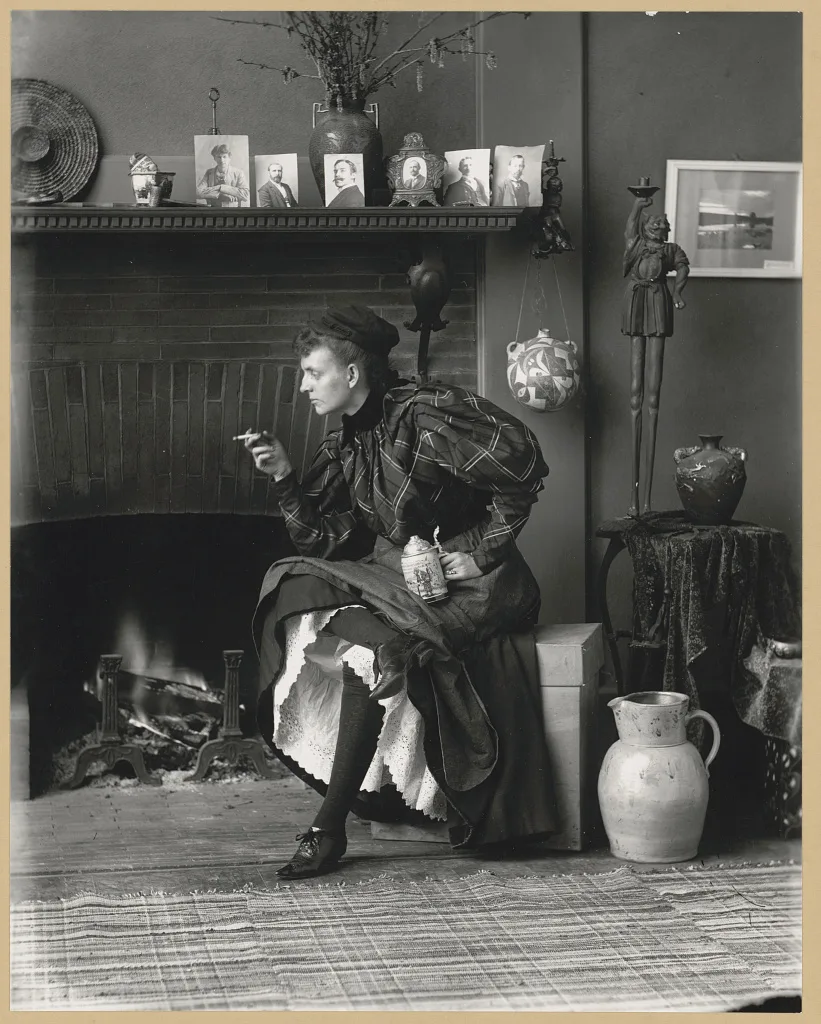
In this self-portrait, made in her Washington, D.C., studio around 1896, Frances Benjamin Johnston sits in profile before the fireplace with a cigarette in one hand and a beer stein in the other, her petticoat showing below her skirt. It is the most widely reproduced picture of the photographer and a classic image of the independent "New Woman" of the 1890s.
- Date
- 1896 (Library of Congress date; some writers say about 1896)
- Medium
- Gelatin silver print mounted on layered paper; photograph 19.7 x 15.7 cm
- Place
- Johnston's studio, Washington, D.C.
- Collection
- Library of Congress Prints and Photographs Division, Frances Benjamin Johnston Collection
- Also called
- Self-Portrait (as "New Woman"); Self-portrait as a Bohemian woman
- Also known as
- Self-Portrait (as "New Woman"); Self-portrait as a Bohemian woman; Frances Benjamin Johnston self-portrait with cigarette and beer stein
How the picture was made
Johnston made this photograph in her own studio in Washington, D.C., the business she had opened in 1894 after training in photography and darkroom work with Thomas Smillie, the head of photography at the Smithsonian Institution. A self-portrait in a studio was a controlled exercise: she chose the chair, the angle, the props and the moment, and then had the exposure made with herself as the sitter. The Library of Congress dates the print to 1896 and describes it as a gelatin silver print mounted on layered paper, with the photograph itself measuring 19.7 by 15.7 centimeters.
The setting is not a neutral backdrop. Johnston's studio was a social space as well as a workplace. In the 1890s, the Clio exhibit on her life explains, she moved between conventional Washington society and a Bohemian circle of artists and writers, and the studio was where the second of those lives took place. Here the fireplace and mantel become a stage set for a performance of character.
What the photograph shows
Johnston sits in profile facing left, close to the hearth. In one hand she holds a lit cigarette and in the other a beer stein. One leg is crossed over the other, and the hem of her skirt is lifted enough to show a ribbon of petticoat. Each detail was a small provocation in the 1890s, when respectable women were not expected to smoke, drink beer or sit with their legs crossed in front of a camera. Writers have pointed out that the pose itself, relaxed and turned away from the viewer, borrows the seated attitude conventionally reserved for men.
The mantelpiece behind her carries six portraits of men, all photographs Johnston had taken herself. The Library of Congress identifies them, from left to right, as the poet Bliss Carman; A. N. Brown, probably the librarian of the U.S. Naval Academy; Henry Guston Rogers, probably the inventor and playwright Henry Gustave Rogers; the architect James Rush Marshall; the Smithsonian librarian Frank Phister; and L. M. McCormick, a photographer and member of the Capital Camera Club. A Library curator has noted that why these particular men were displayed together remains an open question. Read one way, the row of portraits is a display of her professional work; read another, it puts the men on the shelf while she occupies the center of the picture.
The New Woman
The Library of Congress catalog describes the photograph as Johnston posing as an independent "new woman." The term had wide currency in the mid-1890s: the novelist Sarah Grand used it in an influential 1894 article, and it came to stand for women who sought independence through education, paid work and personal freedom. Cigarettes, bicycles and practical dress were the props most often attached to the type, by supporters and by cartoonists who mocked it.
Johnston was a working example of the idea. She ran her own business, sold photographs to magazines and newspapers, and in 1897 published "What a Woman Can Do with a Camera" in the Ladies' Home Journal, urging women to take up photography as a profession. The self-portrait advertises that identity, but it does so with humor. The props are almost too neatly chosen, and the effect is closer to a knowing costume portrait than a confession.
Why it became famous
The picture belongs to a group of playful self-portraits Johnston made in the 1890s. In others she posed in conventional dress as a proper Victorian lady, and in at least two she dressed as a man with a false moustache, one of them with a bicycle; both cross-dressing pictures are also in this archive. The fireplace portrait has outlasted the rest. The Clio exhibit on Johnston calls it the most frequently reprinted of her self-portraits and notes that historians Pete Daniel and Raymond Smock, whose 1974 book A Talent for Detail revived interest in her work, were probably the first to publish it. They wrote that "three symbols of rebellion against Victorian formality appear in this self-portrait." Later scholars, including Laura Wexler in her book Tender Violence, have continued to analyze it.
Its appeal is easy to see. It is a portrait of a photographer by herself, a document of women's changing roles and a joke shared with the viewer, all in a single frame.
Which print this archive holds
This archive presents the Library of Congress print catalogued as "Frances Benjamin Johnston, full-length portrait, seated in front of fireplace, facing left, holding cigarette in one hand and a beer stein in the other, in her Washington, D.C. studio" (Library of Congress item 98502934), the gelatin silver print on layered paper described above. Other reproductions circulate under titles such as Self-Portrait (as "New Woman") or Self-portrait as a Bohemian woman; they derive from the same image. The archive also holds a separate 1896 photograph of Johnston posed with six members of her family by the same studio fireplace, which shows how the room looked in a more formal family portrait.
Frequently asked questions
When did Frances Benjamin Johnston take her New Woman self-portrait?
The Library of Congress dates the self-portrait to 1896. Some writers give it as about 1896. It was made in her studio in Washington, D.C.
What is Frances Benjamin Johnston holding in her famous self-portrait?
A cigarette in one hand and a beer stein in the other. She sits by the fireplace with her legs crossed and her petticoat visible, details that were deliberately unconventional for a woman in the 1890s.
Who are the men in the photographs on the mantel?
They are portraits Johnston took herself. The Library of Congress identifies them as poet Bliss Carman, A. N. Brown, Henry Guston (probably Gustave) Rogers, architect James Rush Marshall, Smithsonian librarian Frank Phister and photographer L. M. McCormick.
What does New Woman mean?
New Woman was a term popular from the mid-1890s for women who sought independence through education, paid work and personal freedom. Johnston, who ran her own photography business, used the self-portrait to play that role openly.
Did Johnston also photograph herself dressed as a man?
Yes. The Library of Congress holds self-portraits from around 1890 in which she wears men's clothing and a false moustache, including one posed with a bicycle. Both are in this archive.
Sources
- Library of Congress, Picture This blog: Frances Benjamin Johnston's Hampton Album, a researcher's exploration (with comment identifying the mantel portraits)
- Clio Visualizing History: Frances Benjamin Johnston, The Artist's Life
- The Story Exchange: Frances B. Johnston challenged stereotypes, and so did her most famous photo
- Wikipedia: Frances Benjamin Johnston
- Wikipedia: New Woman