The Last Photograph of President McKinley (1901)
On the afternoon of September 6, 1901, Frances Benjamin Johnston photographed President William McKinley riding in an open carriage at the Pan-American Exposition in Buffalo, New York, on his way to a public reception at the Temple of Music. Within the hour he was shot there. The picture was later circulated as the last photograph ever taken of McKinley.
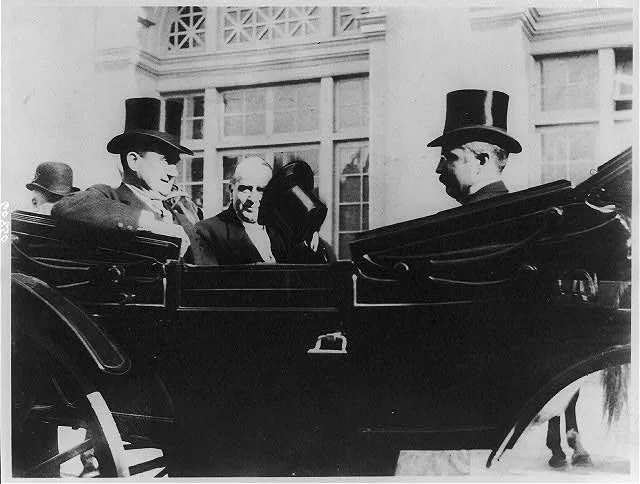
- Date
- September 6, 1901
- Place
- Pan-American Exposition, Buffalo, New York
- Shows
- President William McKinley in a carriage with John G. Milburn and George B. Cortelyou
- Collection
- Library of Congress Prints and Photographs Division (negative LC-J713-1737)
- Medium
- Photographic print
- Also known as
- The last photo ever taken of President McKinley; McKinley on his way to the Temple of Music; McKinley in carriage, Buffalo, 1901
Johnston in Buffalo
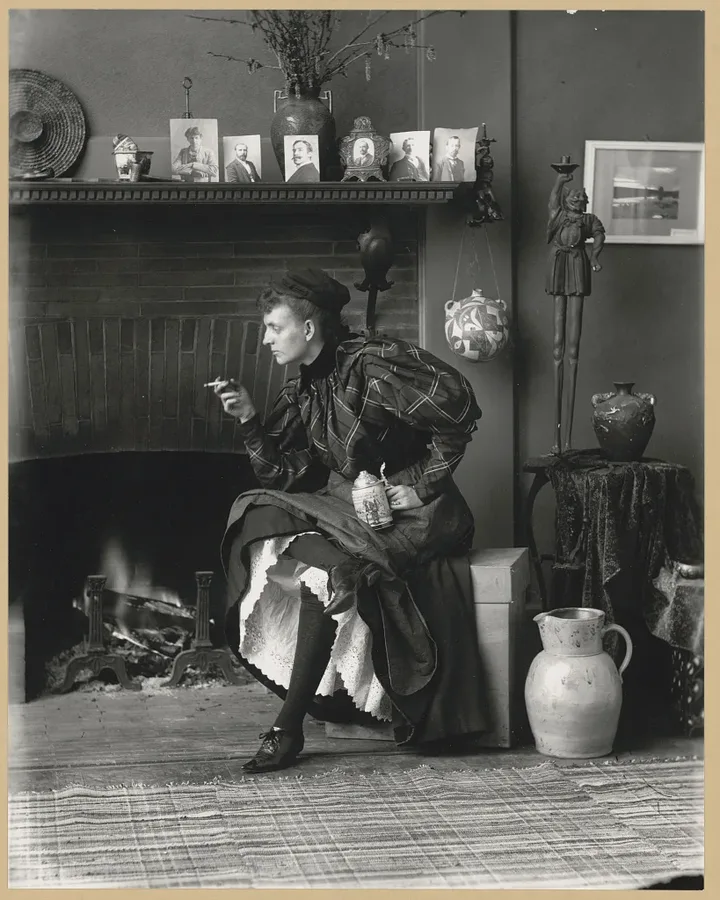
By 1901 Johnston had photographed three presidential administrations. A HistoryNet account describes her as McKinley's official photographer, a role she had also filled for Presidents Cleveland and Harrison. That summer she was in Buffalo under contract to the Buffalo Express to document the Pan-American Exposition, a world's fair celebrating the Western Hemisphere. Her press credentials called her a photo correspondent, and she photographed the fair at least 279 times. She timed her stay to cover McKinley's visit on September 5 and 6.
On September 5 McKinley gave a major speech on trade to a crowd of about 50,000 people on the exposition's Esplanade. Johnston worked close to the stand and made a photograph of him speaking that became one of the most enduring images of the visit. The next day he toured Niagara Falls, returned to the exposition grounds and was scheduled for a brief public reception at the Temple of Music.
What the photograph shows
The Library of Congress title describes the scene precisely: McKinley at Buffalo with John G. Milburn and George B. Cortelyou, riding in a carriage to the Temple of Music, where he was fatally wounded on September 6, 1901. Milburn was the president of the Pan-American Exposition, and McKinley and his wife were staying at his house in Buffalo. Cortelyou was McKinley's secretary. He had twice tried to remove the Temple of Music reception from the schedule because of security concerns, and McKinley twice restored it.
Shortly before the reception, McKinley stopped for refreshments at a building on the grounds. At 4:07 p.m., in the Temple of Music, Leon Czolgosz shot him twice at close range as he greeted the public. McKinley died at the Milburn house early on September 14, 1901. The carriage photograph is ordinary in itself, a man in a top hat on his way to an appointment, and its force comes entirely from what the viewer knows happens next.
Why it became famous, and the competing claims
After the assassination, any picture of McKinley's last hours had news value, and the label "last photograph" was claimed for more than one image. HistoryNet reports that Johnston's photograph of McKinley at a tea at the exposition's Mission building that same afternoon was widely called the last photograph, and that other photographers, including Jimmy Hare, were also credited with the final picture. The Wikipedia account of the assassination reproduces a different image, described as the last posed photograph of McKinley, taken on September 5. The Library of Congress print in this archive carries its own caption calling it the last photo ever taken of the president. No single picture can be confirmed as the last, and the claim is best read as part of how the image was marketed and remembered.
Johnston's Buffalo work became her most widely seen news photography. The Pan-American Exposition's history site notes that she sold postcard-sized copies of her September 5 speech photograph after the assassination and that it is the image most often used to illustrate McKinley's trip to Buffalo. This archive also holds a 1907 broadside advertising those postcards, whose title states that the McKinley National Memorial statue was modeled from her photograph.
What to look for
Look at the people around the president rather than at McKinley alone. The two men beside him were the officials most responsible for his visit: his host, who ran the exposition, and the secretary who had tried to cancel the reception he was riding toward. Notice too what kind of picture this is. Johnston's access to McKinley had come through years of White House portrait work, but this is a news photograph taken on the move, without a pose, the kind of picture she had been making all summer for the Buffalo Express. Its meaning was supplied afterward, by the caption.
Which print this archive holds
This archive presents the Library of Congress photographic print titled "The last photo ever taken of President McKinley, at Buffalo, N.Y., with John G. Milburn and Goerge B. Cortelyou, on his way [in carriage] to the Temple of Music where he was fatally wounded on Sept. 6, 1901" (item 2005683537). The misspelling of Cortelyou's first name is in the original caption. The Clio exhibit on Johnston reproduces the same image from the Library's negative LC-J713-1737. The September 5 speech photograph is a different picture; this archive holds it only as reproduced on the two 1907 postcard broadsides.
Frequently asked questions
Who took the last photograph of President McKinley?
Several photographers were credited with it. The Library of Congress holds Frances Benjamin Johnston's photograph of McKinley riding to the Temple of Music on September 6, 1901, captioned as the last photo ever taken of him.
Who is in the carriage with McKinley?
John G. Milburn, president of the Pan-American Exposition and McKinley's host in Buffalo, and George B. Cortelyou, McKinley's secretary.
Where was McKinley shot?
In the Temple of Music at the Pan-American Exposition in Buffalo, New York, at 4:07 p.m. on September 6, 1901. He died on September 14.
Why was Frances Benjamin Johnston in Buffalo?
She was under contract to the Buffalo Express to photograph the Pan-American Exposition in the summer of 1901, and she timed her stay to cover McKinley's visit.