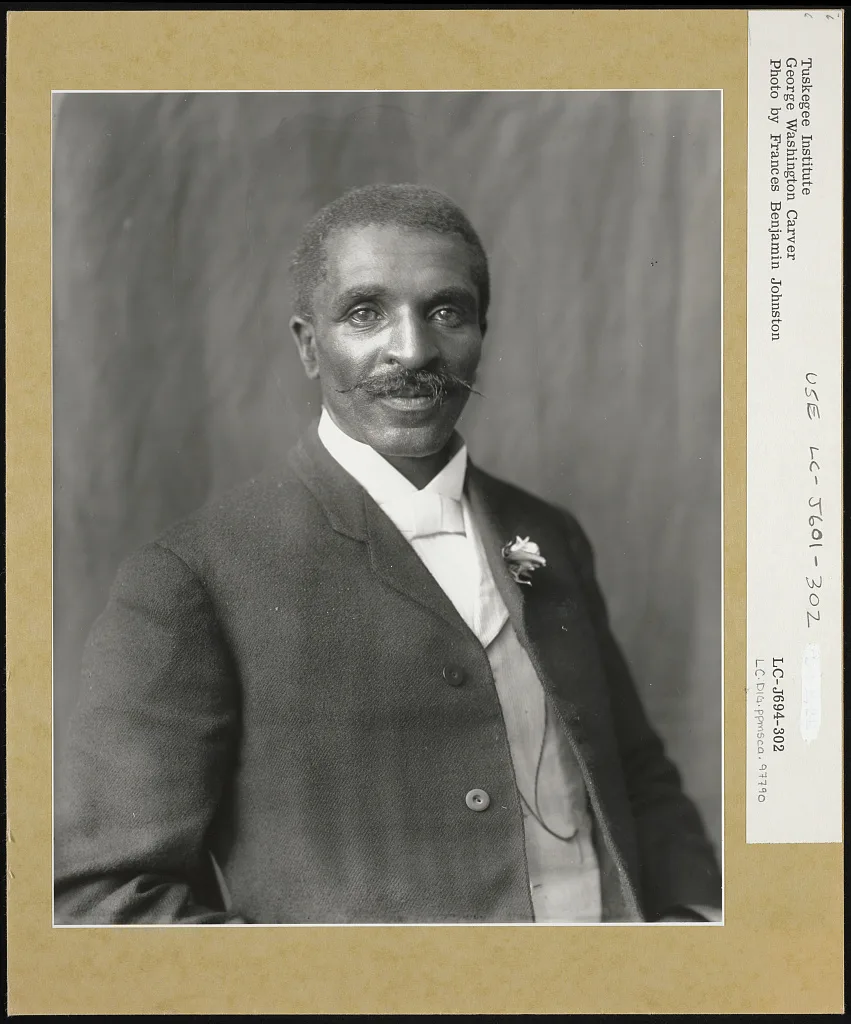
Portrait of George Washington Carver (1906)
In 1906 Frances Benjamin Johnston photographed the agricultural scientist George Washington Carver at Tuskegee Institute in Alabama. Her portraits are among the best-known early images of Carver and are widely reproduced in books and on the web. This page covers the half-length portrait held by the Library of Congress and presented here, and how it relates to her other pictures of him.
- Date
- 1906
- Place
- Tuskegee Institute, Tuskegee, Alabama
- Sitter
- George Washington Carver (c. 1864–1943), head of agriculture at Tuskegee
- Medium
- Gelatin silver print mounted on tan layered paper; sheet 24.2 x 19.4 cm, mount 29 x 24.2 cm
- Collection
- Library of Congress Prints and Photographs Division
- Also known as
- George Washington Carver, Tuskegee Institute, 1906; George Washington Carver by Frances Benjamin Johnston
Johnston at Tuskegee
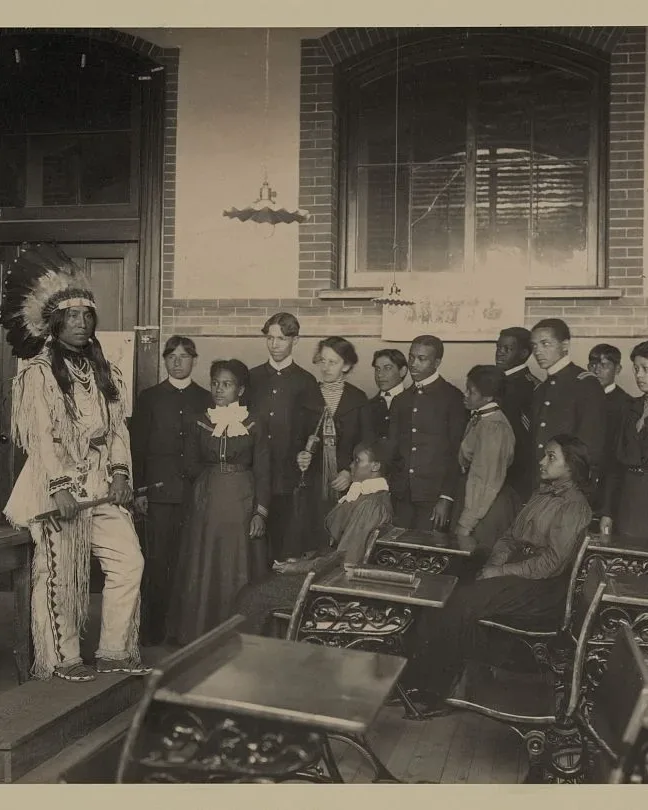
After her Hampton Institute photographs were shown in Paris in 1900, Johnston took on similar work for other schools. In 1902 she traveled to Tuskegee Normal and Industrial Institute in Alabama, founded in 1881 by Booker T. Washington, a Hampton graduate, to make a photographic record of the school. American Heritage magazine, which reproduced several of her Tuskegee pictures, describes a campus crowded with new construction that she framed to show orderly, purposeful activity. It also recounts an incident in which shots were fired near her guide, and her insistence that the person responsible be punished.
She returned in 1906. That year the Library of Congress dates several of her Tuskegee photographs, including classrooms, the library, the woodworking shop, the school's 25th anniversary celebration in April and a group of faculty with Andrew Carnegie. Her portraits of George Washington Carver belong to this period.
The Tuskegee pictures continue the approach of the Hampton series. American Heritage singles out the "tidy busyness" of her campus views, and notes that she framed her pictures to leave out the piles of lumber and brick from the building work going on around her. Her connection to the school's leadership was long-standing: the Library of Congress also holds her portrait of Booker T. Washington, dated about 1895, which is in this archive as well. Portraits of individual faculty members, like this one of Carver, gave the school's teachers the same dignified treatment she gave Washington officials.
Who George Washington Carver was
Carver was born into slavery in Diamond Grove, Missouri, around 1864; the exact date is not known. He became the first Black student at Iowa State, where he later earned a master's degree in 1896 and became the college's first African American faculty member. That same year Booker T. Washington invited him to head Tuskegee's agriculture department, and he taught there for 47 years.
At Tuskegee Carver promoted crop rotation, encouraging farmers to alternate cotton with soil-restoring crops such as peanuts and sweet potatoes, and he developed many uses for those crops. He wrote practical bulletins for farmers and designed a mobile classroom, the Jesup wagon, to take demonstrations to them. He died at Tuskegee on January 5, 1943. When Johnston photographed him in 1906 he had been at Tuskegee for ten years.
What the portrait shows
The Library of Congress catalogs the print in this archive as a half-length portrait of Carver facing right, made at Tuskegee Institute. It is a formal portrait of a faculty member, made by the photographer who had spent the 1890s portraying presidents, cabinet officers and their families in Washington, and it brings that studio manner to an Alabama campus. Half-length portraits of this kind were the standard format for public figures, and Johnston's decision to portray a Black scientist in the same terms she used for officials in Washington is part of what gives the picture its interest today.
The print is mounted on tan layered paper, the kind of finished presentation mount found on many of her portraits in the Library of Congress, rather than an unmounted proof. Compare it with the full-length 1906 photograph of Carver in a field, described below: the field picture shows the agricultural researcher at work, while this one presents the professor.
Other versions
Johnston photographed Carver more than once in 1906. The Library of Congress holds at least two other images from that year. One, digital ID ppmsc.03252, is captioned simply "George Washington Carver. Photo by Frances B. Johnston, 1906"; a restored copy is on Wikimedia Commons. Another, digital ID cph.3c14302, is a full-length view of Carver standing in a field, probably at Tuskegee, holding a piece of soil. The Library also holds a Johnston photograph from around 1902 of Tuskegee faculty with Carver in the front row.
Because the catalog descriptions differ, this archive does not claim that its print is the same negative as the Wikimedia Commons image; compare the two images directly if you need a specific version for citation.
Which print this archive holds
This archive presents the Library of Congress gelatin silver print catalogued as "George Washington Carver, half-length portrait, facing right, Tuskegee Institute, Tuskegee, Alabama" (item 98503047), dated 1906, with a sheet of 24.2 by 19.4 centimeters on a 29 by 24.2 centimeter mount. Related Tuskegee photographs by Johnston in the archive include the 1906 25th anniversary celebration and the faculty group with Andrew Carnegie.
Frequently asked questions
Who photographed George Washington Carver in 1906?
Frances Benjamin Johnston, who photographed Tuskegee Institute in 1902 and again in 1906. The Library of Congress holds several of her 1906 portraits of Carver.
Is Frances Benjamin Johnston's portrait of Carver in the public domain?
Wikimedia Commons marks her 1906 Carver portrait as public domain in the United States because it was published or registered before 1931. For any specific print, check the rights statement on the Library of Congress record.
What did George Washington Carver do at Tuskegee?
He headed the agriculture department from 1896, taught for 47 years, promoted crop rotation with peanuts and sweet potatoes, wrote bulletins for farmers and designed the Jesup wagon, a traveling classroom.
Why did Frances Benjamin Johnston photograph Tuskegee?
After her Hampton Institute series, she was engaged to make a photographic record of Tuskegee in 1902, and she photographed the school again in 1906.
Sources
- Library of Congress, Picture This blog: George Washington Carver, More Than a Name
- Wikimedia Commons: George Washington Carver by Frances Benjamin Johnston
- American Heritage: Tuskegee, Washington's Monument
- Wikipedia: George Washington Carver
- Clio Visualizing History: Frances Benjamin Johnston, The Documentary Eye